Sheetz Allergen Menu: Full Allergy Guide (2026)
Sheetz publishes allergen information through its official interactive nutrition tool at sheetz.com/nutrition, not as a downloadable chart — you look up the item, and the tool shows an ingredients list and an allergen line for it. Because most Sheetz food is Made-to-Order, you can remove ingredients before you order, which genuinely changes the allergen profile of your build. What it does not change is cross-contact: Sheetz states plainly that all food, bakery items, and specialty beverages are prepared in a shared environment where any product can be exposed to known allergens.
That last sentence is the one to hold onto while you read the rest of this page.
The Major Allergens at Sheetz
Sheetz’s own allergen warning names eight allergens by default, and says the list is not limited to them. Here is where each one tends to turn up:
- Milk — the biggest one at Sheetz, and it hides in places people do not expect. Cheese and creamy sauces are obvious; the powdered specialty coffee mixes are not (more on that below).
- Egg — mayo-based and creamy sauces, breakfast egg items, many baked goods.
- Wheat / gluten — sub rolls, buns, wraps, croissants, biscuits, breading on fried items, bakery.
- Soy — extremely common in oils, lecithin, bread products, and processed meats.
- Sesame — buns and bread products are the usual carrier.
- Tree nuts and peanuts — mostly the packaged snack and bakery side of the store rather than MTO food.
- Fish and shellfish — a narrow slice of the menu, but the shared-environment warning still applies.
Sheetz’s warning covers peanuts, tree nuts, soy, wheat, egg, fish, milk, and sesame. Shellfish is part of the FDA’s nine major allergens and is not named separately in that warning, so treat it as covered by the “not limited to” language and confirm in store.
Sheetz Allergen Chart: Common Menu Items
Every row below is taken directly from the allergen field Sheetz publishes in its own tool. Nothing here is inferred.
| Item | Allergens listed by Sheetz |
|---|---|
| Cupo’ccino — French Vanilla | Milk |
| Cupo’ccino — Fat Free French Vanilla | Milk |
| Cupo’ccino — Crème Brûlée | Milk |
| Cupo’ccino — Caramel Brownie Cocoa | Milk |
| Cupo’ccino — Chai | Milk |
| Cupo’ccino — Pumpkin Harvest Spice | Milk |
| Cupo’ccino — Peppermint Mocha | Milk, Soy |
| Hot Chocolate | Milk |
| Brewed coffee (Breakfast Blend, 100% Colombian, House Blend, House Blend Decaf, French Roast, Sumatra) | No allergen listed — black coffee only |
| Fountain drinks (Pepsi, Coke, Dr Pepper, Mountain Dew, Gatorade, Brisk, etc.) | No allergen listed |
The Cupo’ccino finding is the one worth stopping on. Every flavor in that line is built on a “nondairy creamer” — and that creamer contains sodium caseinate, which is a milk derivative. Sheetz’s own tool lists Milk as an allergen for all of them. If you have a dairy allergy and you have been treating the Cupo’ccino machine as a safe bet because the ingredient panel says “nondairy,” that is a mistake worth correcting today. Peppermint Mocha adds soy lecithin on top of it.
This chart is a guide, not a guarantee. Sheetz updates formulations, regional suppliers vary, and any change to your build changes the profile — check your exact item in the tool before you order.
A note on food items: Sheetz provides allergen information through its Nutrition Portal, which includes a Nutrition Calculator, an Interactive Nutrition Menu, and an Allergen Menu. Other menu sites reprint per-item food tables as if Sheetz issued them; it didn’t. Where a food item’s allergens are obvious from its ingredients (breading means wheat, cheese means milk), you can reason about it — but reasoning is not the same as Sheetz’s own data, and it can’t account for supplier changes or your specific build. For anything that matters, look the item up in the tool. It takes about twenty seconds and gives you the ingredient panel for your actual order.
Cross-Contact: What the Chart Can’t Tell You
An allergen chart tells you what is in an item. It cannot tell you what an item touched.
Sheetz’s shared-environment warning is not boilerplate — it is an accurate description of how the kitchen works. Fryers handle multiple products in the same oil. Prep surfaces, tongs, and gloves move between builds during a rush. Blenders and soft-serve equipment carry residue between drinks. The coffee island is self-serve, which means other customers’ spilled creamer is part of the environment.
The practical consequence: an item with no listed allergen can still be exposed to one. Removing cheese from a sandwich at the kiosk removes the cheese, but it does not give you a kitchen that has never handled cheese. For a mild intolerance, customization is usually enough. For an anaphylactic allergy, customization alone is not a safety plan, and no one at Sheetz will tell you otherwise.
How to Order Safely with a Food Allergy
- Check your exact build in the official tool first, before you get in line. Not the item — the build, with your removals applied.
- Tell a staff member directly if your allergy is severe. The kiosk cannot flag your order to the person making it. A human can. Ask for fresh gloves and a clean prep surface.
- Keep the build simple. Fewer components, fewer sauces, fewer chances for a hidden ingredient. Sauces are where milk, egg, and soy stack up fastest.
- Be cautious with anything fried. If the oil is shared, no amount of customization protects you. Ask what else goes in that fryer.
- Use the customization to your advantage. The Made-to-Order system lets you strip a build down to its components at the kiosk, which is more control than most fast food gives you — as long as you treat it as ingredient control, not contamination control.
Dairy-Free & Other Common Allergy Questions
Dairy avoidance at Sheetz is workable with attention. Black brewed coffee carries no listed allergen, and most locations stock a non-dairy milk you can add yourself. Skipping cheese and creamy sauces on an MTO build removes the obvious dairy. What trips people up is the indirect dairy — the Cupo’ccino line above, whey in hot chocolate, and casein in things labeled “nondairy.” Read the ingredient panel in the tool rather than trusting the marketing word on the machine. And the self-serve coffee island is shared equipment used by hundreds of people a day, so the cross-contact caveat holds there too.
Wheat and gluten come up constantly for the same reason bread does — rolls, buns, wraps, and breading are everywhere on the menu, and Sheetz is not a gluten-free facility. That is a big enough topic that it gets its own treatment separately.
Where to Find Sheetz Ingredients & Allergen Info
The interactive tool at sheetz.com/nutrition is the live source of record. It shows the ingredient statement and the allergen line for individual items, and it updates as formulations change. There is no official static Sheetz ingredients list or downloadable allergen PDF — any site offering you one has made it themselves, which means it can be wrong and it can be stale. The Sheetz app provides nutrition details, while in-store nutritional information is available on touchscreens at select stores.
If you are cross-checking calories and macros alongside allergens, the full nutrition breakdown covers that side. And if you are working through what is available before you decide what to look up, the full Sheetz menu lays out the categories.
Frequently Asked Questions
Does Sheetz have allergen information?
Yes. Sheetz publishes allergen and ingredient information through its nutrition tools at sheetz.com/nutrition; the Sheetz app provides nutrition details, and nutritional information is available on touchscreens at select stores. You look up an individual item and the tool shows its ingredient statement and allergen line. It covers the major allergens Sheetz identifies, including milk, egg, wheat, soy, sesame, tree nuts, peanuts, and fish.
Is there a Sheetz allergen menu PDF?
No — Sheetz does not publish an official downloadable allergen PDF or a static ingredients list. The information lives in the interactive tool because builds are customizable and formulations change. Any PDF you find online was made by a third party and is not verified by Sheetz.
Does the MTO kiosk show allergens?
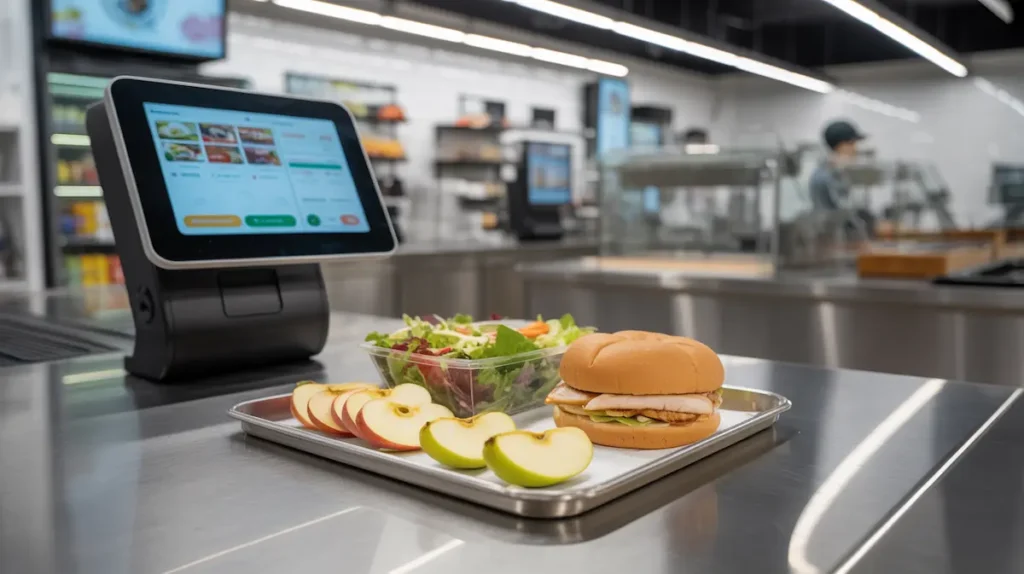
The kiosk lets you see and remove ingredients from your build, which is how most people manage allergens at Sheetz. What it does not do is alert the person preparing your food that you have an allergy. For anything severe, speak to a staff member as well as customizing on screen.
Is Sheetz food gluten-free?
No item at Sheetz is certified gluten-free, and Sheetz is not a gluten-free facility. Some builds can be made without wheat ingredients by removing bread, but shared prep surfaces and shared fryers mean gluten exposure remains possible. Anyone with celiac disease should treat every item as a cross-contact risk.
Does Sheetz sell allergy medicine?
Many Sheetz locations carry basic over-the-counter medicine including antihistamines, but stock varies by store and it is not guaranteed at any given location. This is a convenience-store question rather than a food-safety one — a store shelf is not a substitute for carrying your own prescribed epinephrine if you have a severe allergy.